[et_pb_section fb_built=”1″ theme_builder_area=”post_content” _builder_version=”4.27.4″ _module_preset=”default” custom_padding=”0px|||||”][et_pb_row _builder_version=”4.27.4″ _module_preset=”default” theme_builder_area=”post_content”][et_pb_column _builder_version=”4.27.4″ _module_preset=”default” type=”4_4″ theme_builder_area=”post_content”][et_pb_text _builder_version=”4.27.4″ _module_preset=”default” theme_builder_area=”post_content” hover_enabled=”0″ sticky_enabled=”0″]
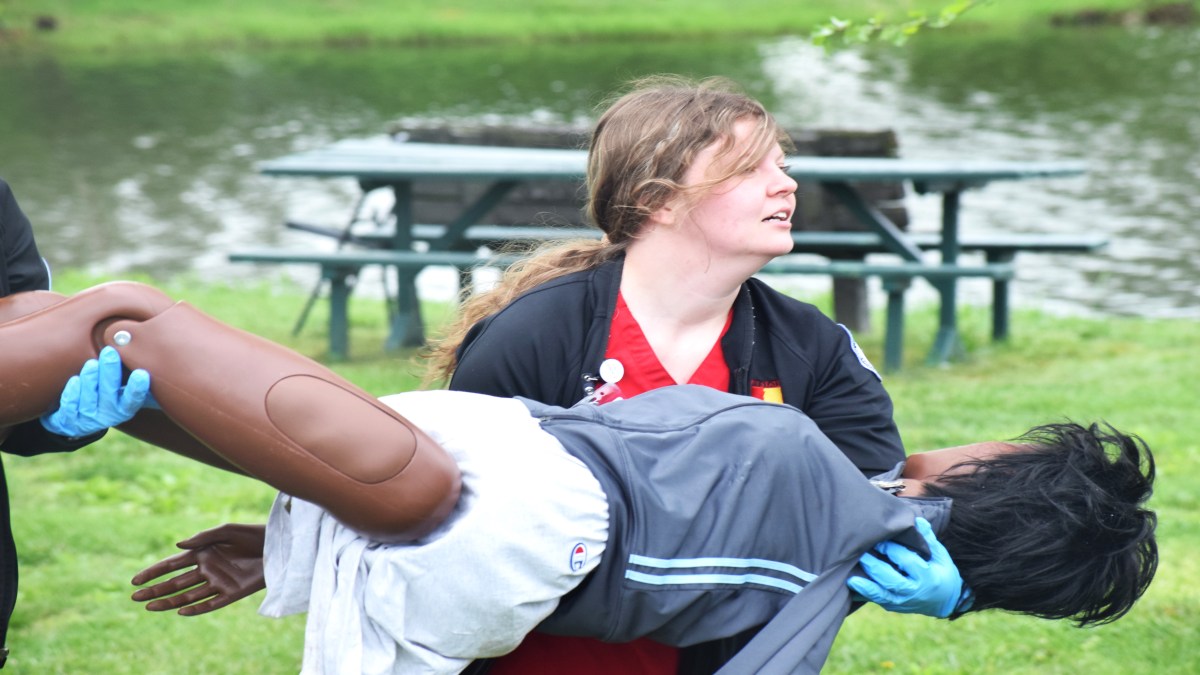
On Disaster simulation held to prepare students for the wors Wednesday, April 15, the Pittsburg State School of Nursing held a disaster simulator, emulating the events of a tornado calamity. This event was designed to prepare nursing and media students for these situations, as well as help imitate the chaos of these tragic scenarios.
There were multiple stations setup throughout the simulation with unique conditions, giving the students a wide range of examples on the kinds of difficulties they could potentially deal with.
To properly strategize, as well as prioritize the resources and time of first responders, they follow a strict system explained by senior nursing student, Natalie Garland.
“We have a triage system that goes black, red, yellow, and then green,” Garland said. “Black meaning the person has passed or is going to pass, red being they need immediate care, yellow indicating that it is serious, but they’re okay to wait a couple hours, and green meaning superficial injuries.”
These kinds of systems keep our responders structured and quick, saving as many lives as possible. Garland expresses that this practice is good for the students and gives them experience in situations they’d otherwise miss out on.
“Honestly, I think the simulation was amazing, and I feel like it brings scenarios to the table that you would never get a chance to see in a hospital,” Garland said.
The Pittsburg State Multimedia and Journalism students also got hands-on experience for this event. Learning how to properly assemble and mediate this kind of incident. Assistant professor of the Department of Communications, Kristen Livingston, explains how this kind of event can show the full depth of these accidents and how it prepares the media team to tackle it.
“It provides insight on if this were to actually happen, how you would battle the chaotic, minute by minute, happenings, alongside the need to get information out,” Livingston said.
Livingston discusses the importance of getting quick, factual information to the public.
“Crisis communication trainings teach us how to get information out in the most efficient way, but also making sure to fact check, as well as make sure everything is presented in an appropriate manner.”
Media personnel play a pivotal role in these crisis situations, relaying important information to news stations and the public. This hands-on training is essential for students to learn and participate in preparing them for this inevitable incident. Freshman Communications major, Julian Johnson explains how the chaos of the simulation is a good one-to-one for a real event, stating
“It’s chaotic, I’ll say that, but an event like this would be just as chaotic, I’m learning a bit about how the first responders operate, their plan of action, and how the news can help in these kinds of events.”
Crawford County Emergency Manager Quinton Parsons, observed and assisted during this simulation. He explained that these simulations are just the first step in the process to recover and coordinate disaster relief.
“This is just the planning phase; we’re working with our local first responders and our nursing and media students to plan for this kind of event.”
Parsons expresses confidence that these simulations prepare our students for the danger and reality of these express conditions, saying, “It’s a fantastic opportunity for our students.”
[/et_pb_text][/et_pb_column][/et_pb_row][/et_pb_section]
 psucollegio