[et_pb_section fb_built=”1″ theme_builder_area=”post_content” _builder_version=”4.27.4″ _module_preset=”default” custom_padding=”0px|||||”][et_pb_row _builder_version=”4.27.4″ _module_preset=”default” theme_builder_area=”post_content”][et_pb_column _builder_version=”4.27.4″ _module_preset=”default” type=”4_4″ theme_builder_area=”post_content”][et_pb_text _builder_version=”4.27.4″ _module_preset=”default” theme_builder_area=”post_content” hover_enabled=”0″ sticky_enabled=”0″]
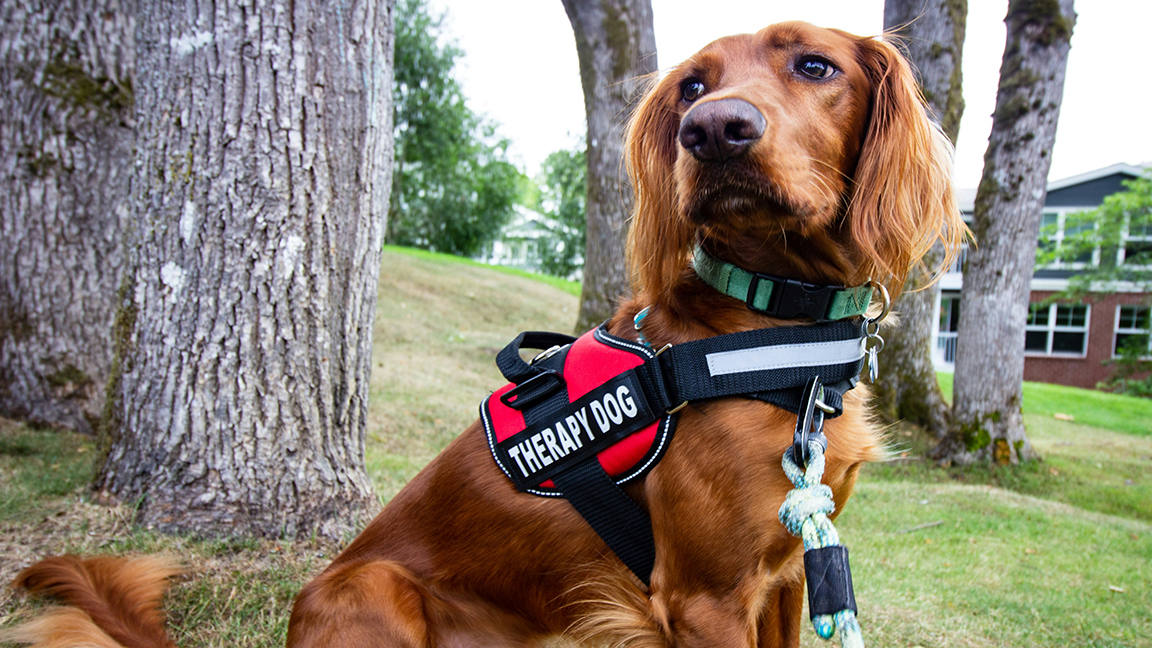
Scout is a therapy dog that is well-known to all who frequent the Bryant Student Health Center. Taylor Panczer, a Wellness & Student Advocacy Services Coordinator at the Health Center, is the proud pet parent of Scout
Therapy can take many forms to best suit the patient. Sometimes this means making art, or music, while sometimes it can just be talking. Scout provides a type of therapy called Pet therapy, or animal-assisted therapy, and specializes in reducing stress and anxiety.
Panczer herself is not a provider, but Scout is fully trained and licensed to perform pet therapy. According to Panczer, Scout “often gets ‘paged’ to medical if a student is anxious about receiving a shot or getting blood drawn… or if the patient is generally feeling anxious, depressed, or just wants to pet a dog!”
Having a dog around can change people, especially because Scout is hyper-sensitive to people feeling stressed or anxious. Panzer said people are different when Scout is not with her.
“If we are walking or coming up to a crowd of people and she targets someone (runs right up to them) I usually know that person is distressed,” Panczer described. “Maybe not showing it externally, but Scout senses it. She will help with folks that are depressed or grieving, but she is more hesitant or rather gives the person more space. In those situations, she will nudge the person to let them know she is there and then walk around them or lay by them, whereas panic attacks or anxiety, she gets really close and asserts herself for them to focus only on her.”
Scout is only brought to work on campus Tuesday and Thursday from 8:30 a.m. to 4 p.m. According to Panczer, no appointments are necessary; you can just come in and request to see her. To make sure she and Scout are available, you can email her directly so she knows to be there at the time you plan to come in.
“Sometimes, I think people get confused and assume because she is certified that she shouldn’t be making any noise. She is still a dog and has emotions just like people do. She knows how to regulate them just like most people do. So if you hear her bark, she isn’t going to attack or bite, it’s just her communicating with you. It’s why as her handler, I need to be able to read her body language and know her cues,” Panczer said.
Stress management is a difficult skill to learn, and even harder to put into practice. Scout got her start in consoling Panzer during a tough time in her life, helping to keep her owner grounded and less anxious. Once Panczer had realized what Scout was doing and how attuned she was to the emotions of others, Panczer went to Logan Martinez of Pet Savvy Training Services to get Scout trained.
Following the initial training, Scout goes through an annual boot camp to brush up on her training while Panczer brushes up on her own training in being Scout’s handler. Panczer had Scout DNA tested and found that she has various kinds of hound dogs in her genetics, but there is one part of her that is an Australian Cattle Dog that loves to work. Scout has shown to love her job and will continue to love her job.
[/et_pb_text][/et_pb_column][/et_pb_row][/et_pb_section]
 psucollegio