[et_pb_section fb_built=”1″ theme_builder_area=”post_content” _builder_version=”4.27.4″ _module_preset=”default” custom_padding=”0px|||||”][et_pb_row _builder_version=”4.27.4″ _module_preset=”default” theme_builder_area=”post_content”][et_pb_column _builder_version=”4.27.4″ _module_preset=”default” type=”4_4″ theme_builder_area=”post_content”][et_pb_text _builder_version=”4.27.4″ _module_preset=”default” theme_builder_area=”post_content” hover_enabled=”0″ sticky_enabled=”0″]
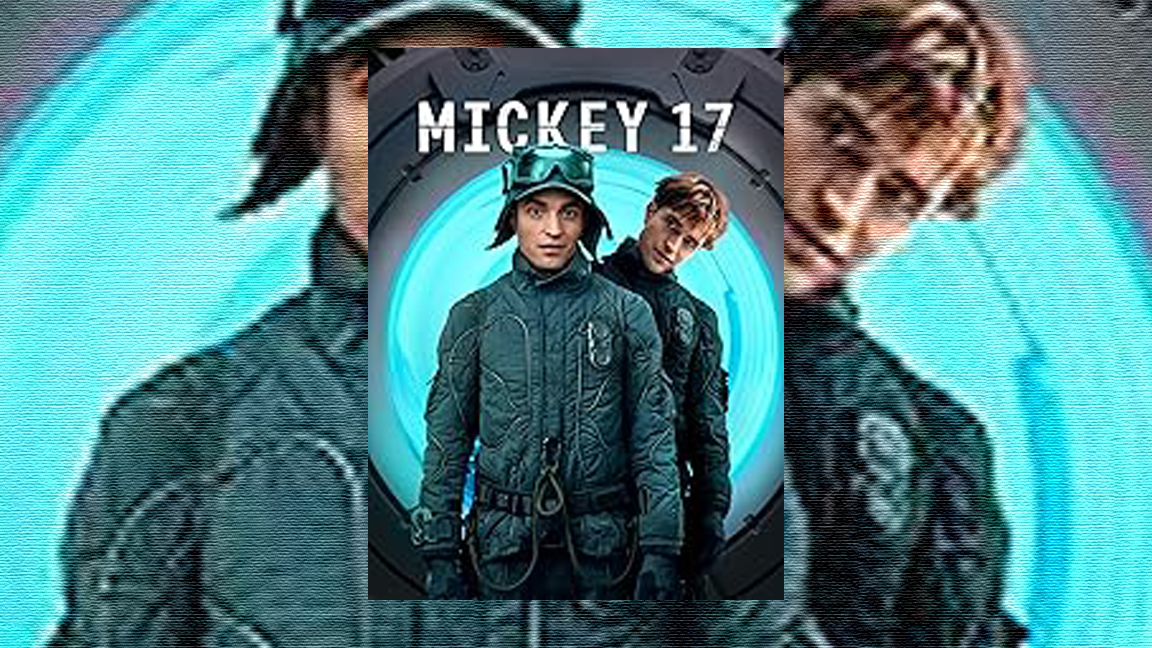
Most people struggle with burnout or long hours at work. In “Mickey 17,” however, the main character faces a far greater risk: Repeatedly dying, horribly dying, every single time. Directed by Academy Award winner Bong Joon-ho, the film blends a science fiction topic, dark comedy, and meta-social satire to explore what human life is worth in a capitalistic-ruled world. With Robert Pattinson in the lead and Naomi Ackie, Steven Yeun, Mark Ruffalo, and Toni Collette supporting, the movie offers an unusual yet thought-provoking look at identity, survival, and worker exploitation in future space colonization.
The film, based on Edward Ashton’s novel “Mickey7,” follows Mickey Barnes as he accepts a risky job as an “Expendable” on a distant planet’s colonization mission. His role includes performing dangerous tasks, such as exploring hostile locations and testing high-risk equipment. Each time he dies, scientists 3-D print a new body for him and upload his memories from a brick, allowing him to return to work for his next assignment. The story begins with the seventeenth version, Mickey 17, who starts to question whether it is right for the system to treat him as disposable, as he is left for dead in a hole.
Robert Pattinson, as always, delivers yet another outstanding performance by making each version of Mickey distinct through changes in voice, body language, and emotions. This lets viewers see that, though they share memories, every Mickey is a little different. Naomi Ackie shines as a character who challenges injustice, while Steven Yeun adds depth as a fellow crew member struggling with the pressures of the mission. Mark Ruffalo and Toni Collette play the amoral leaders who view workers as replaceable slime, managing to be both charming, estranged, and unsettling.
Director Bong Joon-ho, known for “Snowpiercer,” “Okja,” and “Parasite” once again demonstrates his talent for blending genres and delivering relevant social commentary. He skillfully balances humor and tension, often pairing absurd moments with serious questions about life, ethics, and human and animal rights. The film looks striking and stark; the icy alien planet appears cold and dangerous, emphasizing the crew’s isolation and mankind’s obsession with ambition. The cloning labs and technology feature a gritty, realistic style rather than the shiny chrome-lined appearance typical of other sci-fi movies.
The writing explores complex themes. At its core, “Mickey 17” questions whether someone who is cloned again and again remains the same individual or becomes something new. The story also critiques broken and unfair economic systems that prioritize productivity and profit over human life. While these ideas are engaging, the film often loses momentum as it tries to balance philosophical exploration and world-setting flashbacks with a fast-paced sci-fi narrative.
Despite some slow moments, “Mickey 17” stands out as an original sci-fi movie. Its combination of dark humor, strong acting, and thoughtful ideas makes it memorable. Idea-driven science fiction will appreciate its bold story, while those seeking a fast-paced adventure may find it slower and more contemplative than expected.
Overall, “Mickey 17” is a bold, unique movie that continues Bong Joon-ho’s tradition of blending entertainment with awareness-raising about global social issues. Robert Pattinson’s stellar performance is a highlight of his range, and the film asks challenging questions about identity, mortality, and humanity
[/et_pb_text][/et_pb_column][/et_pb_row][/et_pb_section]
 psucollegio