[et_pb_section fb_built=”1″ theme_builder_area=”post_content” _builder_version=”4.27.4″ _module_preset=”default” custom_padding=”0px|||||”][et_pb_row _builder_version=”4.27.4″ _module_preset=”default” theme_builder_area=”post_content”][et_pb_column _builder_version=”4.27.4″ _module_preset=”default” type=”4_4″ theme_builder_area=”post_content”][et_pb_text _builder_version=”4.27.4″ _module_preset=”default” theme_builder_area=”post_content” hover_enabled=”0″ sticky_enabled=”0″]
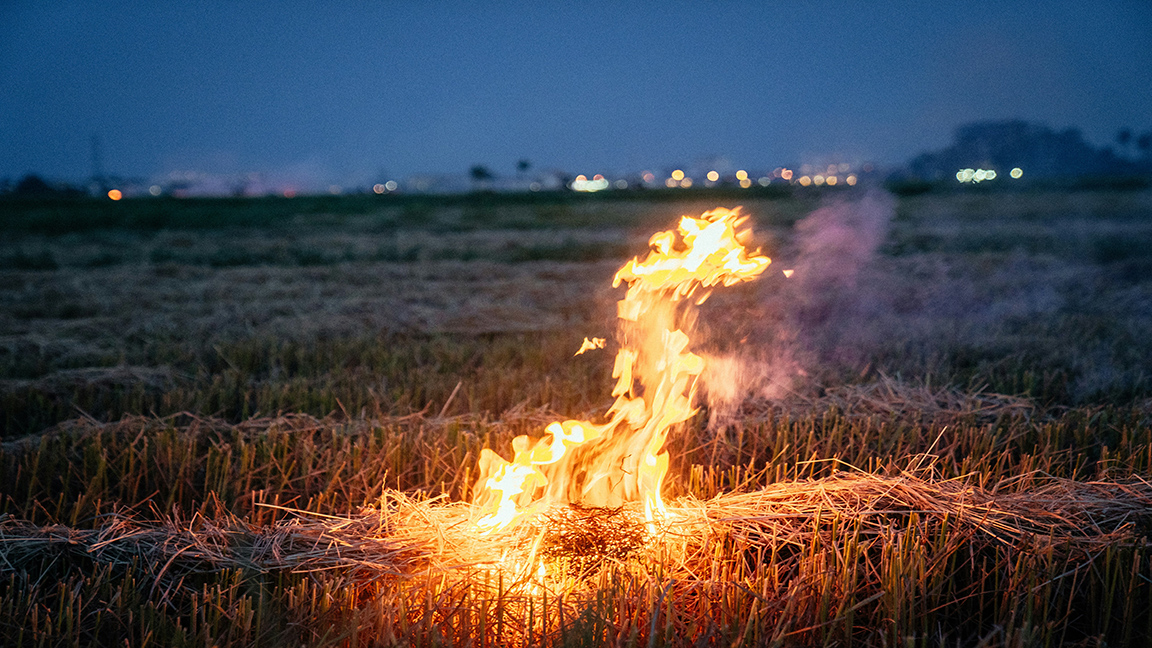
Over winter break, a small group of Pittsburg State University biology students got hands-on experience with conducting prescribed prairie burns at Prairie State Park in Missouri. The experience is part of an ecological management class taught by Dr. Andrew George, associate professor of biology. The students learned how to safely conduct and control the fire as well as how to use chainsaws to clear invasive species of trees. The burns are needed to protect the natural prairie ecosystem, the natural wildlife, and return nutrients like nitrogen to the soil.
Two of the students who attended were Caleb Stradley, a sophomore double majoring in biology with emphasis in wildlife ecology and geography, and Eva Arb, a sophomore double majoring in biology with emphasis in wildlife ecology and conservation and art with emphasis in studio practice.
George, Arb, and Stradley described fire as a needed tool used by natural resource managers to maintain the prairie. The burns help to strengthen the prairie ecosystem and remove invasive species.
“Fire is natural,” George said. “Fire is one of the many tools that natural resource agencies use. What managers are trying to do is recreate or mimic the natural disturbance regime prior to European colonization.”
“The prairie is a habitat that thrives on prescribed burns,” Arb explained. “It needs burns to get rid of the dead and invasive plants.”
“The invasive plants don’t fit the proper niche, and a lot of these invasive species disrupt the harmony,” Stradley said.
Arb added that the burns bring nutrients back into the soil and bring the natural wildlife of the prairie back to the area. George added that trees such as cedar are removed to keep the grassland from becoming an unnatural forest.
“The burns recycle the dead plant material, so that helps the soil, which in turn helps microorganisms,” Arb said. “It helps bring back in wildlife because it creates more habitat for them, especially like prairie birds like the greater prairie chicken and meadowlark, those are ground birds that don’t nest in trees because the trees aren’t supposed to be on the prairie. We were cutting down a lot of cedar that’s not supposed to be there.”
“One of the biggest challenges in the Great Plains right now is woody encroachment or woody invasion,” George said. “Forests and shrub lands are gradually creeping into the Great Plains for a lot of different reasons. Fire suppression is probably the primary reason, and increased carbon dioxide in the atmosphere contributes to the invasive species. That is the primary challenge for folks who manage prairies and grassland systems all through the Great Plains.”
Arb said the teamwork was very effective. Arb described the tools used to prep the area and maintain the fire.
“Everybody worked together real quick,” Arb said. “They go out with the tractor and cut down the encircling area, and then we go out with leaf blowers to blow all the grasses and stuff a couple feet away from the line so that it would prevent the fire from creeping out and catching onto the area behind us. We had water trucks; we were going out and spraying it, and those of us with the ploppers and rakes were smothering the fire.”
Arb said the burns can only be performed at certain times of the year with conditions that will best suit safety.
“There’s a certain period of time that’s best suited for them: Winter to early spring,” Arb said. “You need perfect conditions, everything from humidity to the weather, to the wind – all these elements combine (to determine) it’s safe to do a prescribed burn.”
Stradley explained that even after carefully determining that the conditions were perfect, conditions changed and the burn had to be cancelled. Arb said the change in conditions caused spot fires to form outside of the designated area.
“One of the days,” Stradley said, “we had a guy from the Missouri Department of Conservation, as well as the State Park Manager, go out for a long time to make sure everything was perfect. And then decided to do the burn, and we ended up having to cancel part of the way though because out of nowhere it got windier and started blowing fire back behind the fire line.”
“We were getting spot fires,” Arb said, “which are when the fire gets behind us, and it creates a different spot of fire, and you have to quickly put that out. Otherwise, it could burn the area that you don’t want, and that’s why you have a line.”
Arb said that the hands-on experience was invaluable compared to lectures in being able to fully understand the process. Arb also described the importance of personal safety.
“It’s a good experience because you can be lectured, but until you experience something like that yourself, you don’t really understand,” Arb said. “I knew fire is going to be smoky, I’ve worked with fire before. But you don’t realize how smoky it can be with the different things that get burned until you’re there, like I was crying the whole time because of the smoke getting in (my) eyes. Being careful and making sure that you don’t push your physical limits (is important), because we had enough people there to switch with someone to get away from the fire and smoke.”
The hands-on experience with conducting prescribed burns is part of an ecological management class. George described the class as designed to give students skills needed for their careers. Arb describes the class as a commitment.
“This course is part of our field biology program,” George said. “It’s designed to give students practical, marketable skills. A good portion of our biology students at Pitt State are looking for careers in natural resources, wildlife management, and fisheries management. It really helps with entry level jobs if they’re fire certified, can work a chainsaw, can drive an ATV, and use herbicide. So that’s what this course is all about.”
“It’s an ecological management class for Dr. George,” Arb said. “Not (just) anybody can be in it, you have to get permission from Dr. George. This is definitely a commitment; you’re working hands-on with Andrew (Braun), who’s the head at Prairie State Park. It helps if you have previous experience, like participating in WFS, which is the Wildlife Fisheries Society, so we do a lot of hand-on activity.”
Arb described the feeling of accomplishment and recommended readers to get certified. Stradley encouraged students to join WFS.
“Seeing that accomplishment with a group of people, talking about the experience afterwards, it was goosebumps,” Arb said. “I was a part of this and I made a difference. We succeeded and we’re improving this habitat. Just an amazing experience, I would recommend people to get certified.”
“Something for students, join WFS,” Stradley said. “It’s a lot of fun if you love wildlife, going out in nature, and just like animals in general. It’s a very open and friendly group.”
[/et_pb_text][/et_pb_column][/et_pb_row][/et_pb_section]
 psucollegio